
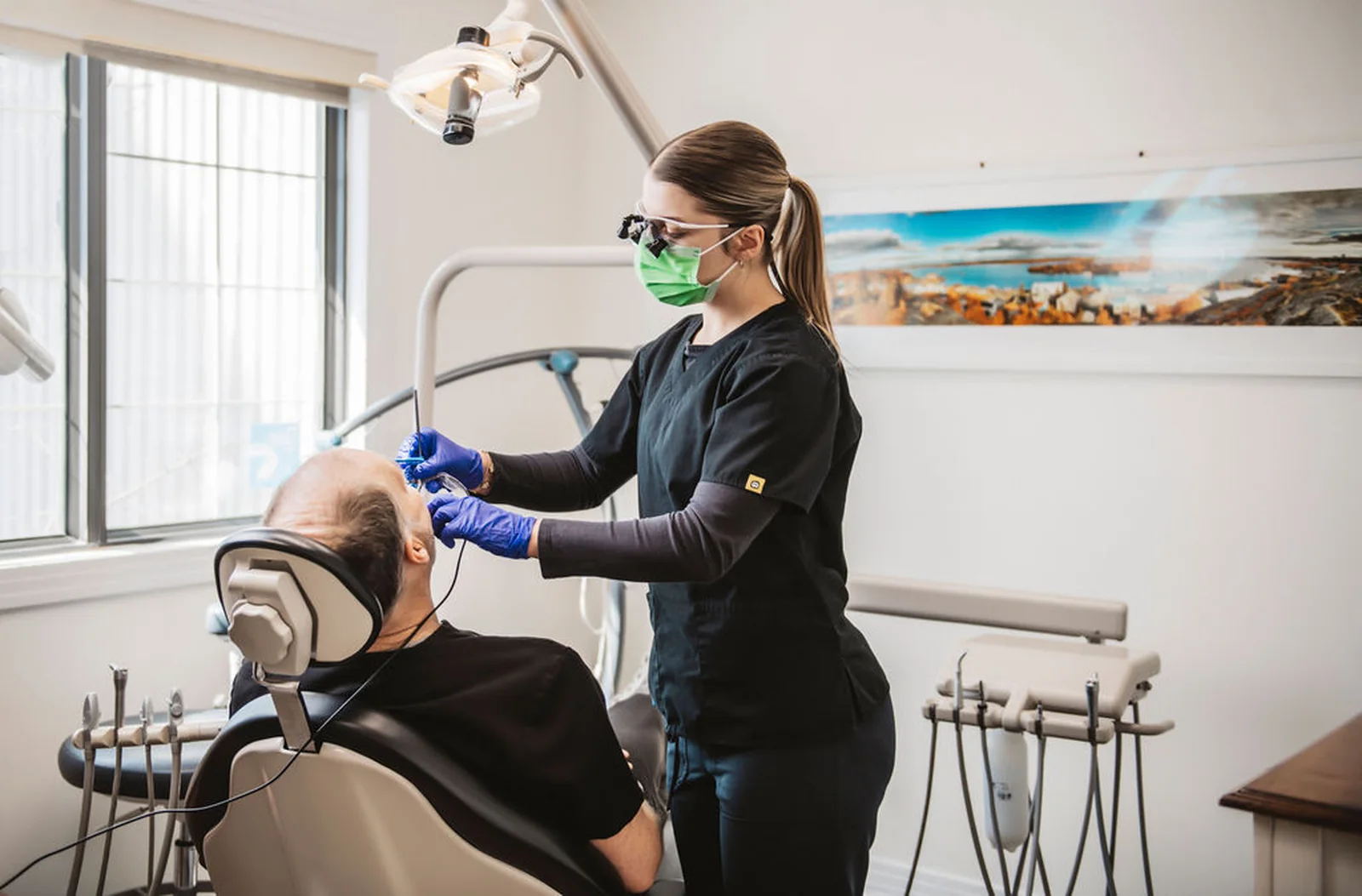
Waking up with a sore jaw, or a headache that starts at your temples?
Clenching and grinding are easy to miss, because most of it happens while you're asleep. What you notice is the aftermath — a tight jaw first thing, headaches that start at the temples, teeth that feel tender, or a partner who mentions the noise. It's common, it's treatable, and the first step is working out what's actually going on.
How we work out what's driving it
There's no single cause, so we start by looking rather than guessing. We check how your teeth meet, look for the wear patterns grinding leaves on the biting surfaces, feel the jaw muscles and the joint itself for tenderness, and ask about the things that tend to travel with it — stress, sleep, caffeine, a new crown that doesn't feel quite right. That assessment is what decides the treatment; the same symptoms can come from quite different places.
Night guards
The most common first step. A custom guard is made from impressions of your own teeth, so it fits closely and is comfortable enough to actually wear — which matters, because an uncomfortable guard ends up in a drawer. It won't stop you clenching, but it takes the force off your teeth and often eases the morning tightness. Expect it to wear down over time; that wear is the guard doing its job instead of your enamel.
TMJ appliances
If the jaw joint itself is involved — clicking, locking, pain opening wide — a guard alone may not be the right answer. TMJ appliances are designed to change how the jaw rests rather than simply to protect the teeth. We'll explain which one we think applies to you and why, and if your case would be better handled by a specialist we'll say so and arrange the referral.
Other options
For some patients with persistent muscular jaw tension there are additional treatment options beyond appliances. Whether any of them suit you depends on your assessment and your medical history, so it's a conversation to have at your appointment rather than something to decide from a website.
What it costs
A custom night guard is a defined procedure with a set fee, and many insurance plans cover part of it. We'll give you the exact figure before anything is made, and run a predetermination with your insurer if you'd like their written estimate first. No work starts until you've seen the number.
Common questions
How do I know if I grind my teeth?+
Most people don't, until someone tells them or we spot the wear. The usual signs are a tight or tired jaw in the morning, headaches around the temples, teeth that feel sensitive to cold without an obvious cause, or small flattened areas on the biting surfaces. We can usually tell from the wear pattern at a check-up.
Will a night guard stop the grinding?+
It protects your teeth from the force rather than stopping the habit itself, and many people find the morning tightness eases. If the grinding is driven by something else — stress, or a sleep issue — we'll talk about that too, because the guard alone won't address it.
Is jaw pain always from grinding?+
No. It can come from the joint, the muscles, a tooth problem, or sometimes from something unrelated to the mouth entirely. That's the reason for the assessment — treating the wrong cause is how people end up with an appliance that doesn't help.
Do I need a referral?+
No, you can book directly. If your case turns out to need a specialist we'll tell you and arrange it.
Related services
Sedation Dentistry in Yellowknife
If the thought of sitting in a dental chair makes your heart rate go up, you're not unusual — dental anxiety is one of the most common reasons people put off care. We see it every week, and we don't treat it as something to get over. We treat it as something to plan around.
Family Dentist in Yellowknife
We see a lot of families where the parents came in first and now bring their kids — and in a few cases, their parents too. Family dentistry means everyone comes to the same place and we know your family's dental history. Your five-year-old's first checkup and your mom's crown replacement happen down the same hallway. When something does need a specialist, we'll say so and arrange the referral.

Ready when you are.
Book online any time, or call reception and we’ll find you a slot. In pain? Say so when you call and we’ll get you seen as soon as we can.